
 EN
EN
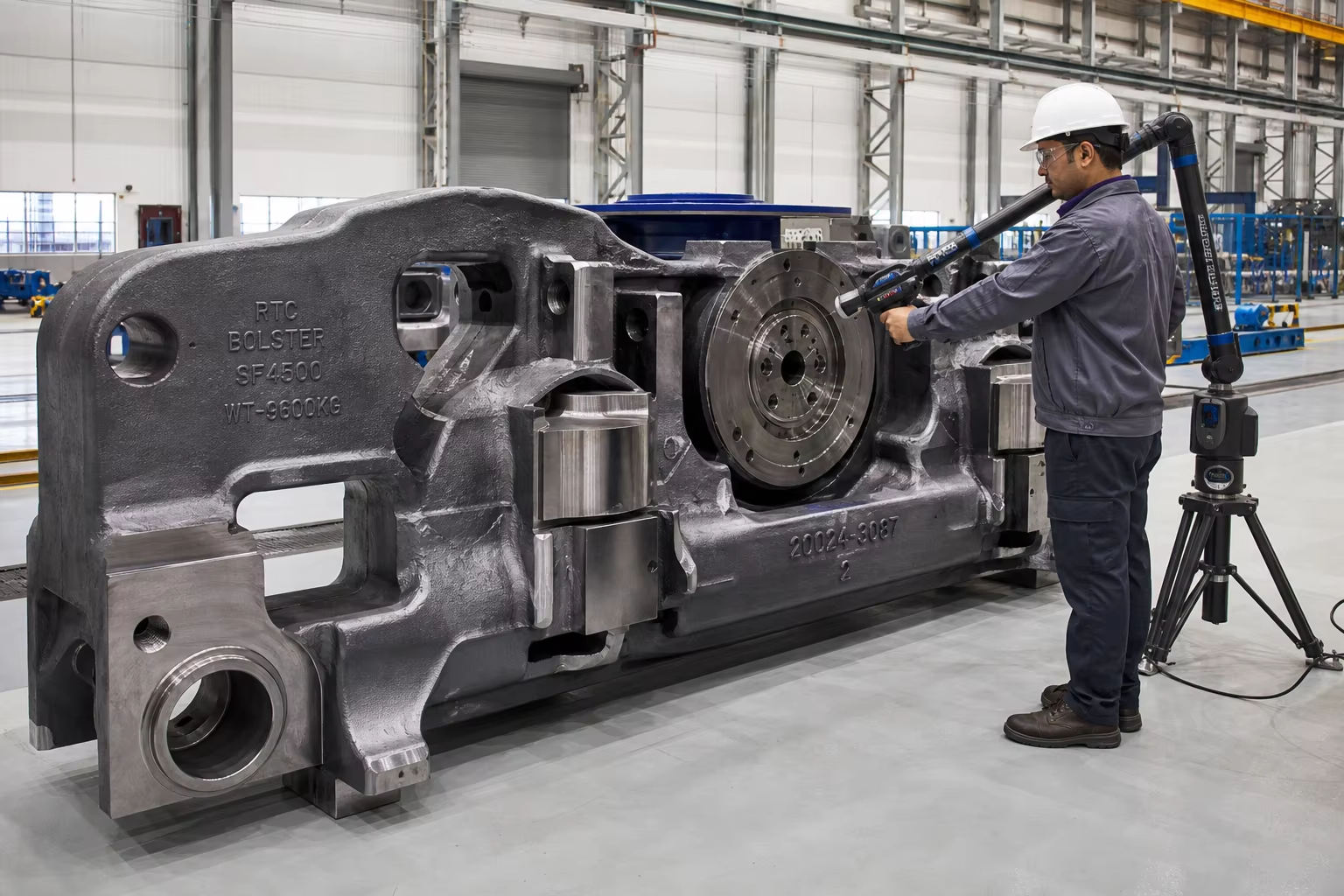
Meta Description: A complete technical guide to railway bogie and rolling stock steel castings. Explore AAR M-201 Grade B+, Grade C, and Grade E specifications, side frame and truck bolster casting integrity, high-cycle fatigue life, automated green sand molding, and CNC pedestal machining.
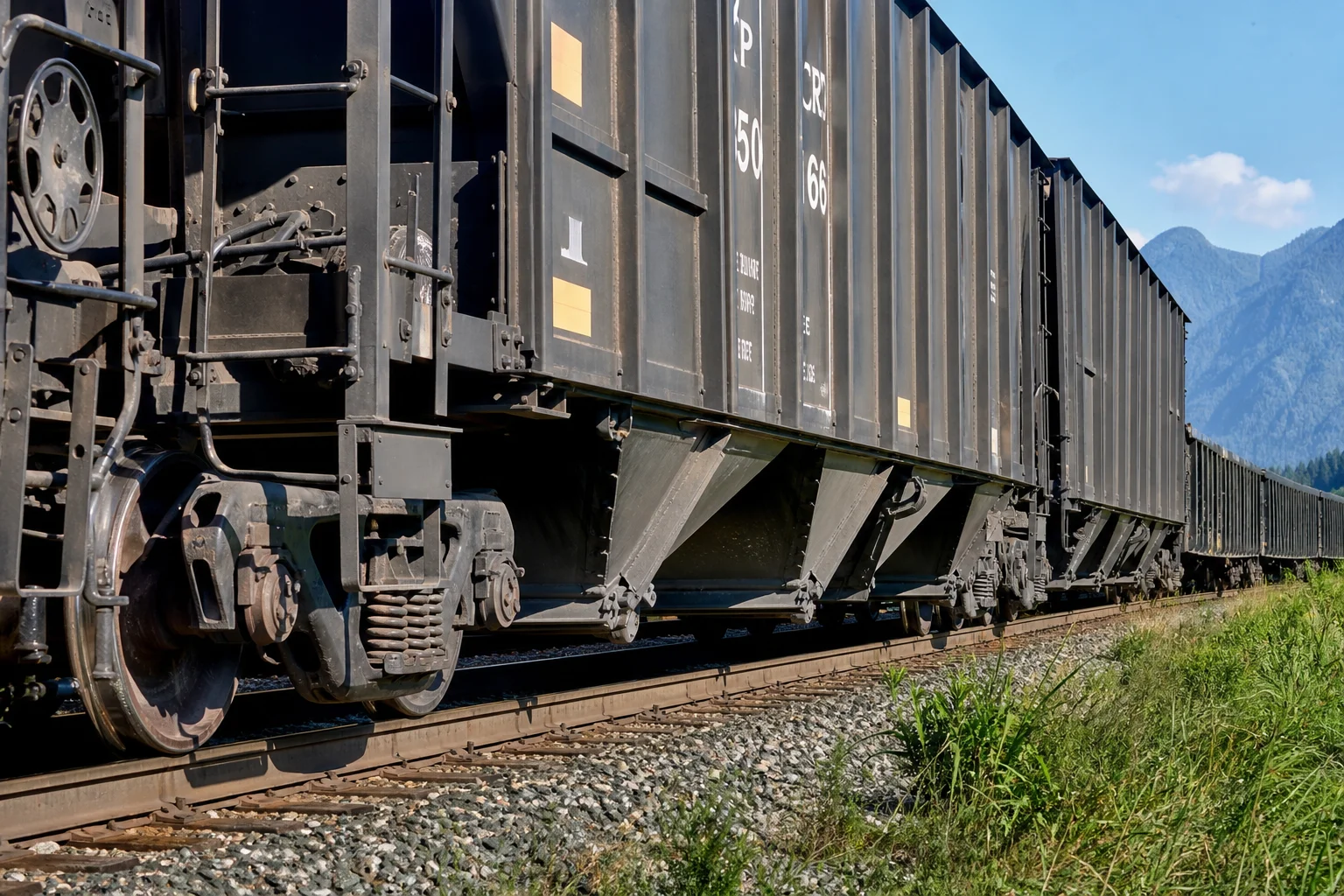
In freight rail transportation, heavy-haul mining trains, and passenger rolling stock, the railway bogie (truck) assembly is the single most safety-critical structural subsystem. A standard 100-ton freight car bogie relies on massive, precision-cast steel Side Frames, Truck Bolsters, Center Plates, Coupler Bodies, and Draft Gear Housings to support dynamic vehicle gross weights up to 130 metric tons per car at operating speeds up to 120 km/h.
Operating over millions of cumulative track kilometers, railway bogie castings endure continuous high-amplitude cyclic vertical shock impacts (rail joints and track switches), lateral hunting oscillation fatigue, longitudinal buff-and-draft coupler collisions (), and extreme environmental temperature swings ().
Because a catastrophic fatigue fracture of a bogie side frame causes high-speed train derailment, railway castings are subject to the world’s strictest structural safety standards — governed in North America by the Association of American Railroads (AAR M-201 / M-214) and internationally by EN 10293 and ISO 9001 / IRIS (International Railway Industry Standard).
This engineering guide provides an exhaustive technical analysis of railway cast steel grades, directional feeding design, heat treatment protocols, automated green sand molding, multi-axis CNC pedestal machining, and comprehensive NDT validation.
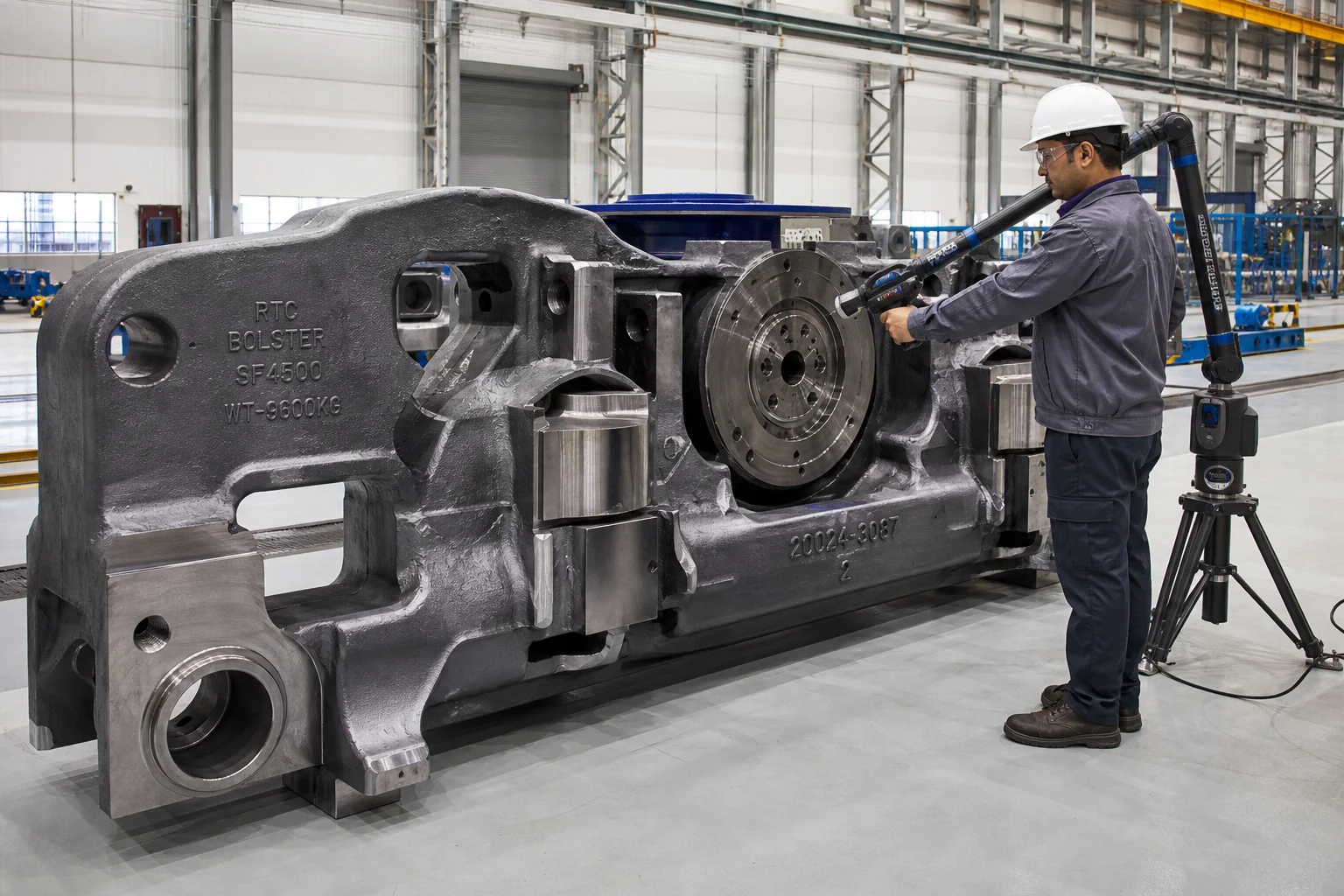
1. Operating Dynamic Stress Fields & Failure Modes of Railway Castings
Railway side frames and bolsters function as heavy structural dynamic bridges transmitting multi-directional impact energies:
                      ┌──────────────────────────────────────────────┐
                      │ Heavy Rail Dynamic Track Load (>30 Ton/Axle) │
                      └──────────────────────┬───────────────────────┘
                                             │
        ┌────────────────────────────────────┼────────────────────────────────────┐
        ▼                                    ▼                                    ▼
┌───────────────────────────────┐  ┌───────────────────────────────┐  ┌───────────────────────────────┐
│ High-Cycle Track Fatigue      │  │ Heavy Coupler Buff Impact     │  │ Sub-Zero Cold-Climate Impact  │
│ (Rail joint impact cycles     │  │ (Longitudinal train braking   │  │ (Arctic brittle fracture risk │
│  exceeding 10,000,000 cycles) │  │  forces >1,800 kN)            │  │  at -40 °C ambient temp)      │
└───────────────────────────────┘ └───────────────────────────────┘ └───────────────────────────────┘| Bogie Component | Primary Dynamic Load | Critical Failure Mode to Prevent | AAR Structural Standard |
|---|---|---|---|
| Truck Side Frame | High-cycle vertical bending + lateral hunting oscillation | Transverse fatigue cracking at the bottom spring seat fillet and column transitions | AAR M-201 Grade B+ / Grade C (Normalized / Q&T) |
| Truck Bolster | Center plate vertical loading () + dynamic side bearing rocking | Center plate bowl fatigue wear and bottom tension flange cracking | AAR M-201 Grade B+ / Grade C |
| Type E / Type F Coupler Body | Longitudinal tensile draft and compressive buff collision forces | Knuckle pin lug shearing, coupler shank bending fatigue | AAR M-201 Grade E (Quenched & Tempered Alloy Steel) |
| Draft Gear Housing & Yoke | Extreme kinetic shock absorption during heavy train run-in/run-out | Housing body wall rupture, pocket distortion | AAR M-201 Grade E () |
2. Metallurgical Alloy Standards for Railway Castings (AAR M-201 & EN 10293)
The Association of American Railroads (AAR) specification M-201 categorizes cast steels into distinct structural grades:
| Material Specification | Heat Treatment Condition | Tensile Strength () | Yield Strength () | Elongation () | Reduction of Area () | Charpy V-Notch (CVN) Impact | Primary Application |
|---|---|---|---|---|---|---|---|
| AAR M-201 Grade B+ | Normalized & Tempered (N&T) | at | Standard freight car side frames, bolsters, brake beams | ||||
| AAR M-201 Grade C (Q&T) | Quenched & Tempered (Q&T) | at | Heavy-haul mining car side frames, cold-climate bogies | ||||
| AAR M-201 Grade E (Q&T Alloy) | Quenched & Tempered (Q&T Alloy Steel) | at | High-tensile couplers, knuckles, draft gear yokes | ||||
| EN 10293 G20Mn5 | Normalized / Q&T | at | European freight wagon bogies (Y25 type), brake discs |
Metallurgical Focus: Strict Nitrogen, Sulfur, and Phosphorus Control
Fatigue crack initiation in railway castings occurs almost exclusively at non-metallic inclusion clusters.
- Tramp Element Thresholds: Phosphorus () and Sulfur ().
- Deoxidation & Rare-Earth Treatment: Molten steel undergoes basic ladle refining with calcium wire injection and controlled aluminum addition to achieve fine Type III spheroidal manganese sulfides, completely eliminating brittle intergranular Type II eutectic film sulfides.
3. High-Integrity Sand Molding & Directional Solidification
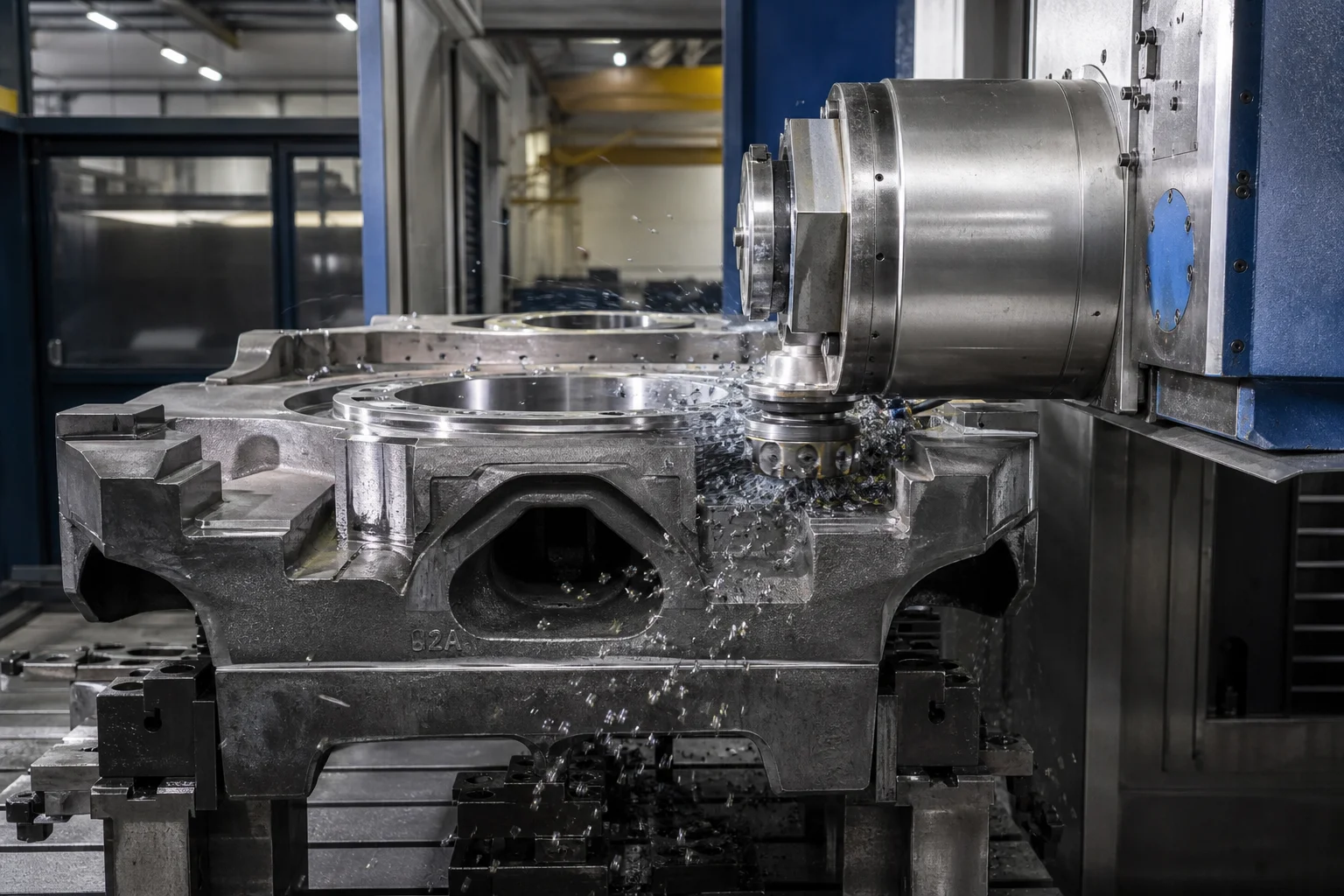
Side frames and bolsters are large hollow box-section castings (length , weight ) with intricate internal lightening cores and variable wall thicknesses ().
┌─────────────────────────────────────────────────────────────┐
│ 1. 3D Precision Metal Tooling & Machine Pattern Mounting    │
│    • Heavy cast iron / machined aluminum patterns           │
├─────────────────────────────────────────────────────────────┤
│ 2. Automated High-Pressure Flaskless Green Sand / Resin Sand│
│    • High mold hardness (>90) to eliminate mold wall motion │
├─────────────────────────────────────────────────────────────┤
│ 3. Automated Core Setting with Precision Core Prints         │
│    • Cold-box phenolic resin internal cores                 │
│    • Rigid core print locking prevents internal wall shift  │
├─────────────────────────────────────────────────────────────┤
│ 4. Computer-Simulated Multi-Ingate Gating & Insulated Risers│
│    • Bottom-fill gating prevents oxide skin folding         │
│    • Direct-chills placed at high-stress R-radii junctions   │
└─────────────────────────────────────────────────────────────┘
4. Multi-Stage Heat Treatment Protocols (AAR M-201)
To achieve the rigorous Charpy V-notch low-temperature toughness requirements ( at ):
As-Cast Steel Bogie Frame
            │
            ▼
┌────────────────────────────────────────────────────────┐
│ 1. Full Austenitizing (900 °C – 930 °C)                │
│    (Complete homogenization and grain refinement)      │
└───────────┬────────────────────────────────────────────┘
            │
            ▼  High-Agitation Polymer/Water Quench OR Air Blast
┌────────────────────────────────────────────────────────┐
│ 2. Rapid Quenching / Normalizing                       │
│    (Transforms coarse structure to fine Ferrite-Pearlite│
│     or Martensite/Bainite)                             │
└───────────┬────────────────────────────────────────────┘
            │
            ▼
┌────────────────────────────────────────────────────────┐
│ 3. High-Temperature Tempering (600 °C – 660 °C)        │
│    (Eliminates residual stresses; maximizes toughness) │
└────────────────────────────────────────────────────────┘
5. Precision CNC Pedestal & Center Plate Machining
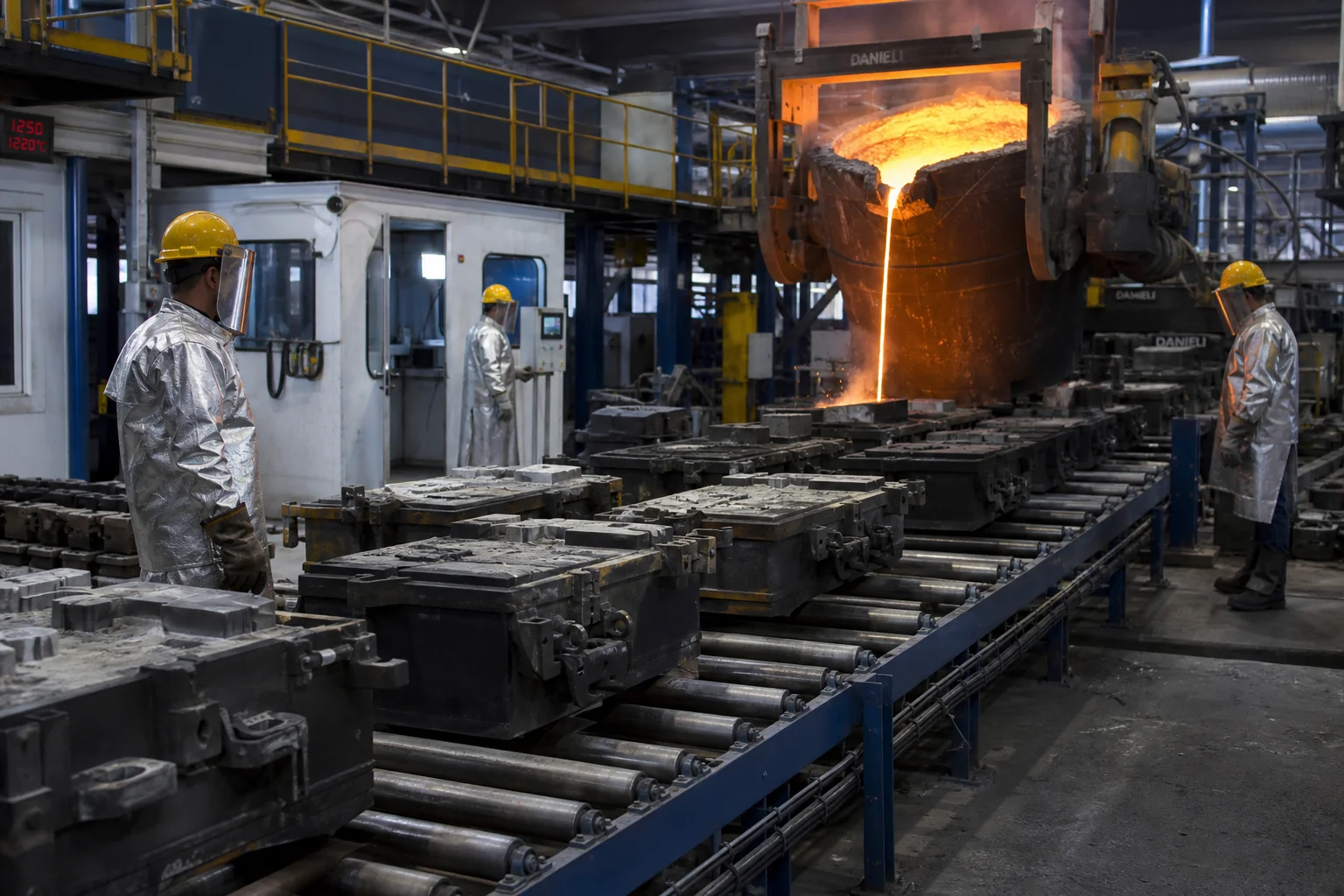
Bogie castings must interface accurately with wheelset axle bearings, friction snubbers, and the vehicle body underframe:
Critical Machined Interfaces:
- Side Frame Pedestal Jaws: The pedestal jaw thrust faces, roof, and friction wear plate mounting surfaces are precision machined on CNC horizontal boring centers. Pedestal spacing and squareness are maintained within across the entire 2.5-meter wheelbase.
- Bolster Center Plate Bowl & Side Bearings: Center plate bowl diameter and depth machined to (), ensuring uniform contact with the car body center bowl without localized binding during curve negotiation.
- Brake Rigging & Bushing Holes: Multi-axis drilling and reaming of brake lever pin holes fitted with manganese steel or hardened composite wear bushings.
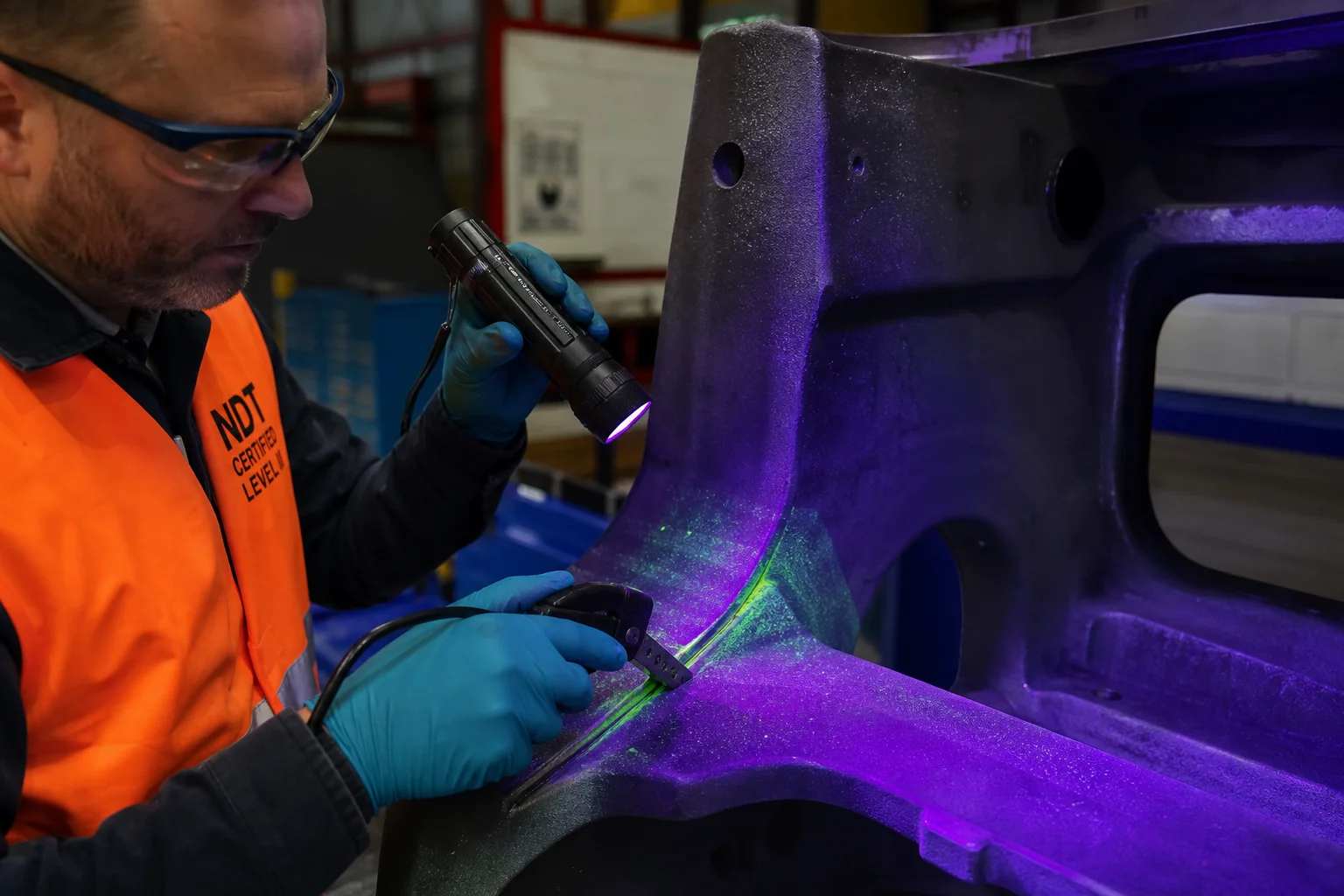
6. Comprehensive Non-Destructive Testing (NDT) & AAR Quality Compliance
| Quality Test Category | Standard / Specification | Acceptance Criteria |
|---|---|---|
| Radiographic Testing (RT) | ASTM E446 / ASTM E186 | Level 1/2 in critical tension flanges, spring seats, and pedestal corners |
| Magnetic Particle Testing (MT) | AAR M-214 / ASTM E709 (Fluorescent) | 100% inspection of all high-stress radii and machined pedestal jaws; zero cracks |
| Static & Dynamic Proof Test | AAR M-202 / M-203 Static Deflection Rig | Bolster loaded to rated capacity; zero permanent plastic deformation |
| Tensile & Impact Toughness | ASTM E8 / ASTM E23 on attached test coupons | Strict conformance to AAR M-201 tables; CVN at |
| Dimensional Scanning | 3D Laser Tracker / Go/No-Go Gauge Fixtures | Full verification of kingpin center-to-pedestal dimensions per AAR drawings |
7. Railway Casting Manufacturing at Dandong City Pengxin Machinery Co., Ltd.
Delivering high-reliability railway bogie and rolling stock castings demands certified foundry quality infrastructure, advanced heat treatment capabilities, and large-scale CNC machining centers.
Dandong City Pengxin Machinery Co., Ltd. is an established heavy casting and precision machining powerhouse serving the global rail transit, mining, and heavy equipment industries:
- Comprehensive Rail Steels: Certified production of AAR M-201 Grade B+, Grade C, Grade E, EN 10293 G20Mn5, and high-strength alloyed steel castings.
- Heavy Foundry Infrastructure: 80,000 m² production plant with automated green sand and resin sand lines, capable of casting single components from 100 kg to 25 tons.
- Precision Multi-Axis CNC Machining: Large-envelope horizontal boring mills and dedicated multi-spindle machining centers delivering finished pedestal jaws and bolster center plates.
- In-House Quality Laboratory: Certified Level II/III NDT personnel conducting 100% MT, UT, and RT inspections, accompanied by optical emission spectrometry and Charpy low-temperature impact testing down to .
- Full Quality Documentation: Certified under ISO 9001, providing complete EN 10204 3.1 material certificates, NDT inspection logs, and AAR dimensional verification reports.
Conclusion
Railway bogie and rolling stock castings are foundational structural elements that bear the dynamic weight and shock loads of global freight and passenger transportation. Achieving million-kilometer fatigue lives requires zero compromise in steel deoxidation purity, low-temperature impact toughness (), directional solidification modeling, precision CNC pedestal machining, and comprehensive NDT validation.
Partnering with an experienced, integrated heavy casting and precision machining facility ensures that your rolling stock components run safely, reliably, and efficiently across the world's railway networks.
Contact Dandong City Pengxin Machinery Co., Ltd. to submit your railway casting specifications or request custom engineering consultations.
Dandong City Pengxin Machinery Co., Ltd. — Heavy Castings and Precision Machining, Since 1958.
Table of Contents
- 1. Operating Dynamic Stress Fields & Failure Modes of Railway Castings
- 2. Metallurgical Alloy Standards for Railway Castings (AAR M-201 & EN 10293)
- 3. High-Integrity Sand Molding & Directional Solidification
- 4. Multi-Stage Heat Treatment Protocols (AAR M-201)
- 5. Precision CNC Pedestal & Center Plate Machining
- 6. Comprehensive Non-Destructive Testing (NDT) & AAR Quality Compliance
- 7. Railway Casting Manufacturing at Dandong City Pengxin Machinery Co., Ltd.
- Conclusion