Meta Description: A technical guide to slag pot design, materials, and manufacturing for steel mills. Learn about trunnion designs, thermal fatigue resistance, sand casting of 5–50 ton steel pots, heat treatment, CNC machining, and quality assurance — from a leading slag pot foundry.
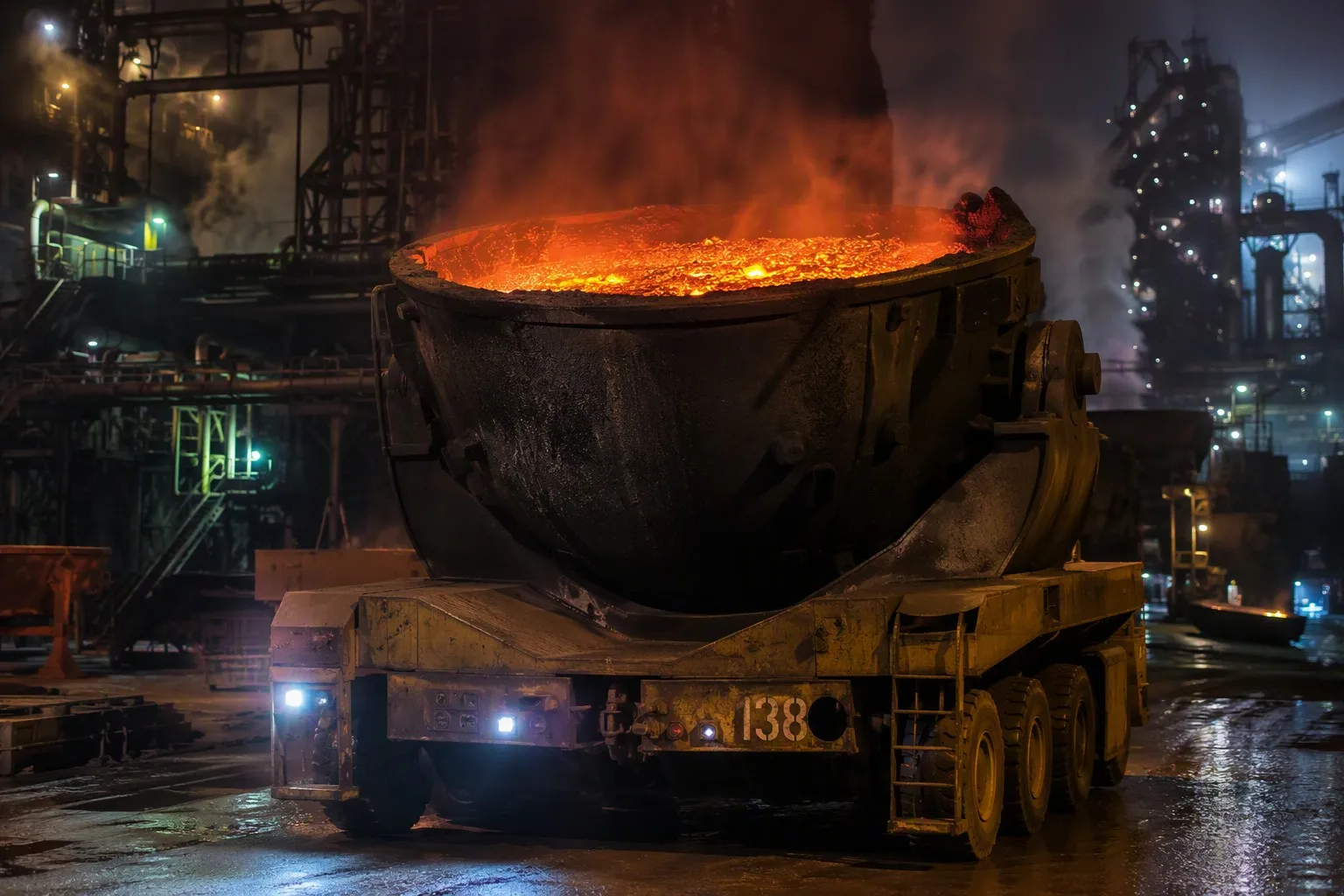
Every steel mill produces slag — the molten byproduct of ironmaking and steelmaking that carries away impurities from the metal bath. And every slag handling system depends on one workhorse component: the slag pot. Weighing anywhere from 5 to 50 tons, cast in steel, and exposed to molten slag at 1,300–1,600 °C on every cycle, the slag pot is one of the most demanding castings produced anywhere in the world.
Yet despite its critical role, slag pot design and manufacturing are poorly documented in public literature. Most engineering guides cover valves, pumps, and machine components — few address the specialized metallurgy and manufacturing challenges of heavy-section steel castings that operate at the extreme edge of thermal and mechanical loading.
This guide provides a comprehensive engineering overview of slag pot casting: function, design configurations, material selection, the casting and machining process, quality assurance, and service life management.
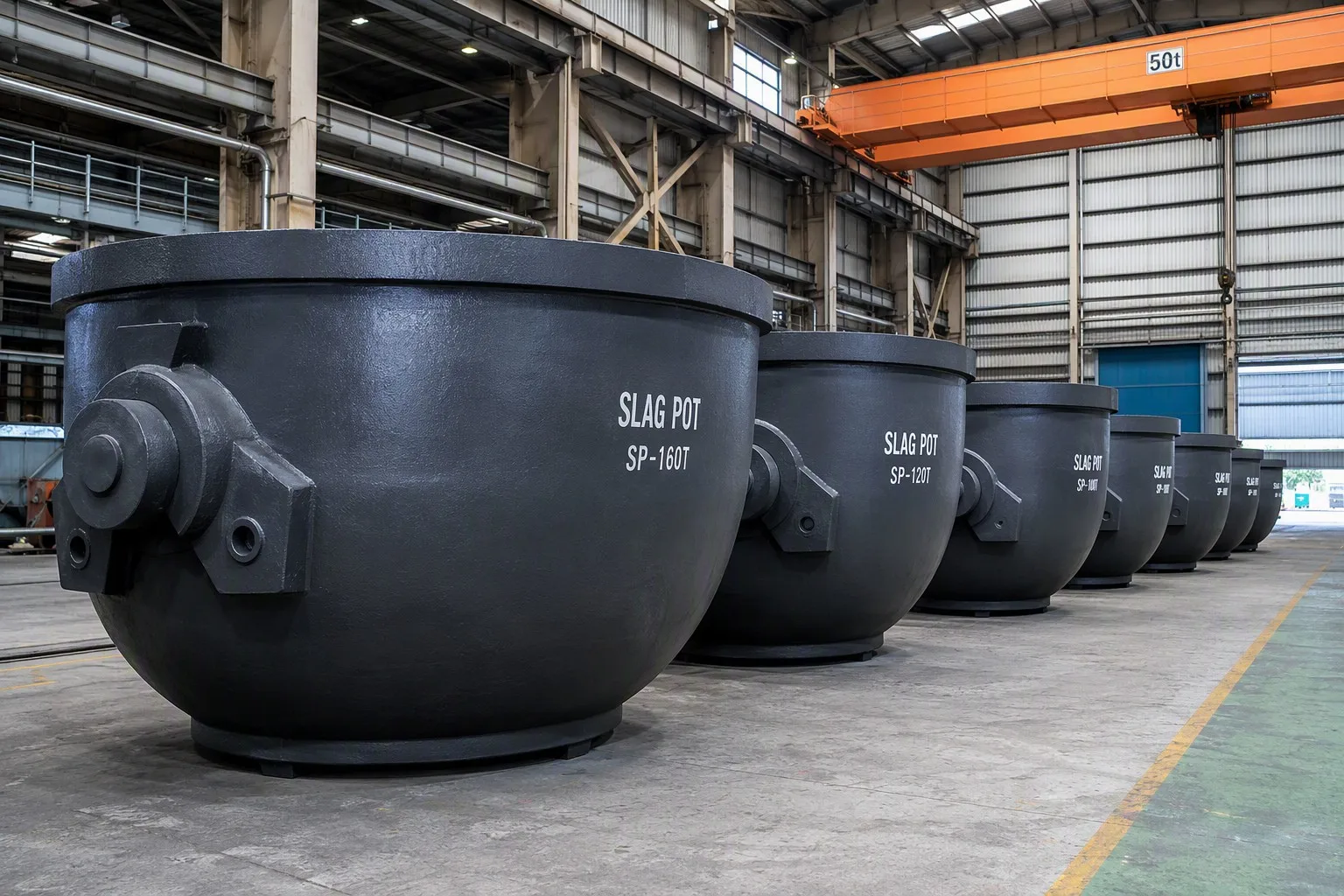
A slag pot (also called a slag ladle, cinder pot, or desulphurization pot depending on the application) is a heavy-walled, bowl-shaped steel casting that collects molten slag discharged from furnaces, converters, and ladle treatment stations.
| Application | Slag Temperature | Typical Pot Capacity | Cycle Frequency |
|---|---|---|---|
| Blast furnace (ironmaking) | 1,400–1,550 °C | 15–50 m³ | 8–12 pots per day |
| Basic oxygen furnace (BOF) | 1,500–1,650 °C | 10–25 m³ | 10–20 pots per day |
| Electric arc furnace (EAF) | 1,450–1,600 °C | 5–20 m³ | 10–15 pots per day |
| Ladle furnace / refining | 1,500–1,650 °C | 3–10 m³ | 5–10 pots per day |
| Desulfurization station | 1,300–1,500 °C | 3–15 m³ | Intermittent |
Each slag pot cycle subjects the casting to extreme conditions:
The pot body undergoes repeated thermal cycling from near-ambient to slag temperature — this is the fundamental design driver for slag pot metallurgy: thermal fatigue resistance.
Slag pot geometry is a balance of functional requirements:
| Geometric Feature | Design Purpose |
|---|---|
| Tapered bowl profile | Facilitates slag release when tilted; allows the solidified slag to release cleanly |
| Generous mouth rim radius | Distributes thermal stress; prevents rim cracking from slag overflow |
| Thickened bottom section | Withstands slag impact during filling; provides structural stiffness |
| Trunnion boss reinforcement | Carries the full pot weight plus slag during lifting and tilting |
| Integral feet/pads | Provide stable rest position when the pot is set down |
The trunnions are the most highly stressed features of a slag pot — they carry the entire pot-plus-slag weight (up to 100+ tons) during lifting and tilting.
| Trunnion Type | Description | Advantages | Considerations |
|---|---|---|---|
| Cast-in trunnions (integral) | Trunnions are cast as part of the pot body | No weld seams; strongest option; best fatigue performance | Requires more complex pattern and molding; NDT of trunnion-to-body junction critical |
| Bolted trunnions | Separate cast or forged trunnions bolted to the pot body | Trunnions replaceable without replacing the pot; simplifies casting | Bolted joint requires periodic inspection; adds machining operations |
| Forged trunnions (welded) | Forged steel trunnions welded into machined bosses | Highest trunnion material quality; common for very large pots | Weld quality critical; requires PWHT after welding |
Industry trend: Integral cast-in trunnions are preferred for pots up to ~25 tons because they eliminate the weld joint — the most common failure location. For very large pots (>30 tons), forged trunnions welded into the body are often specified for superior trunnion toughness and defect-free material.
Slag pots are emptied by tilting. The tilt mechanism determines the trunnion and lifting lug design:
| Tilt System | Pot Design Impact |
|---|---|
| Crane + trunnion bail | Standard trunnion pair on opposite sides; crane hook engages a C-hook or bail |
| Slag pot carrier (articulated truck) | Trunnions or lift pins positioned for the carrier's arms; the carrier lifts and tilts the pot |
| Rail car with tilt mechanism | Pot mounted on a rail car; tilt frame engages integral trunnions |
| Direct tilt (hydraulic tipper) | Pot body with tilt trunnions; the tipper mechanism rotates the pot |
The pot lip (mouth rim) is the hottest zone — it receives slag splash and overflow, and is directly exposed to radiation from the molten slag surface. Lip design options:
| Design | Thermal Fatigue Performance | Cost |
|---|---|---|
| Integral rim (standard) | Moderate — rim is the first area to crack | Baseline |
| Reinforced rim (thickened, radiused) | Improved — larger radius distributes thermal stress | +10–15% weight |
| Replaceable rim band | Best serviceability — rim ring is a separate casting bolted or welded | Highest initial cost; lowest lifecycle cost for high-frequency pots |
Slag pot material selection is dominated by one requirement: resistance to thermal fatigue cracking. Each service cycle generates:
| Material | Tensile (MPa) | Yield (MPa) | Elongation (%) | Thermal Fatigue Performance | Cost Index |
|---|---|---|---|---|---|
| Plain carbon steel (WCB-type) | 485–620 | 250–275 | 22 | Moderate — adequate for low-frequency service | 100 |
| Low-alloy Cr-Mo steel (1.25Cr-0.5Mo, A217 WC6-type) | 485–655 | 275 | 20 | Good — Cr-Mo improves high-temperature strength and creep resistance | 130–150 |
| Low-alloy Cr-Mo steel (2.25Cr-1Mo, A217 WC9-type) | 485–655 | 275 | 18 | Very good — higher Cr-Mo content improves oxidation and thermal fatigue resistance | 150–180 |
| Modified carbon steel (carbon + Cr-Ni additions, custom) | 550–650 | 300–350 | 18–22 | Good — balanced cost and thermal fatigue performance; commonly specified by major slag pot users | 110–130 |
Most slag pot specifications in the global steel industry use a modified carbon steel — a standard carbon steel chemistry enhanced with controlled chromium, nickel, and sometimes molybdenum additions:
Typical modified carbon steel specification for slag pots:
| Element | Typical Range |
|---|---|
| Carbon (C) | 0.22–0.30% |
| Silicon (Si) | 0.30–0.60% |
| Manganese (Mn) | 0.60–1.00% |
| Chromium (Cr) | 0.40–0.80% |
| Nickel (Ni) | 0.30–0.70% |
| Molybdenum (Mo) | 0.10–0.30% (optional for high-frequency service) |
| Phosphorus (P) | 0.035% max |
| Sulfur (S) | 0.030% max |
Why this chemistry works:
| Treatment | Temperature | Purpose |
|---|---|---|
| Stress relief anneal | 590–650 °C | Eliminate solidification residual stress before machining |
| Normalize | 880–920 °C | Refine grain structure; homogenize microstructure across heavy sections |
| Temper (after normalize) | 620–660 °C | Improve toughness; reduce hardness to machinable range (140–180 HB) |
The heat treatment of heavy-section castings (wall thickness 80–250 mm) requires extended holding times — typically 1 hour per 25 mm of section thickness, plus 1–2 hours soak. For a pot with 200 mm maximum section, the normalize cycle alone may require 10–12 hours at temperature.
Slag pot patterns are among the largest produced in any foundry. Key pattern engineering considerations:
| Element | Engineering Consideration |
|---|---|
| Shrinkage allowance | Steel shrinks approximately 2–2.5% linearly from liquid to ambient — the pattern must be scaled up accordingly |
| Draft angles | 1–2° external; internal surfaces require draft toward the opening for pattern/core withdrawal |
| Core design | The interior cavity is formed by a large sand core — core prints must provide secure location against buoyancy forces from 40+ tons of molten metal |
| Rigging (gating and risers) | Multiple risers (typically 4–8) positioned around the rim and at trunnion bosses; gating through the bottom or multiple ingates to minimize turbulence |
| Chills | External chills at heavy junctions (trunnion-to-body, bottom-to-wall) to accelerate solidification and prevent shrinkage |
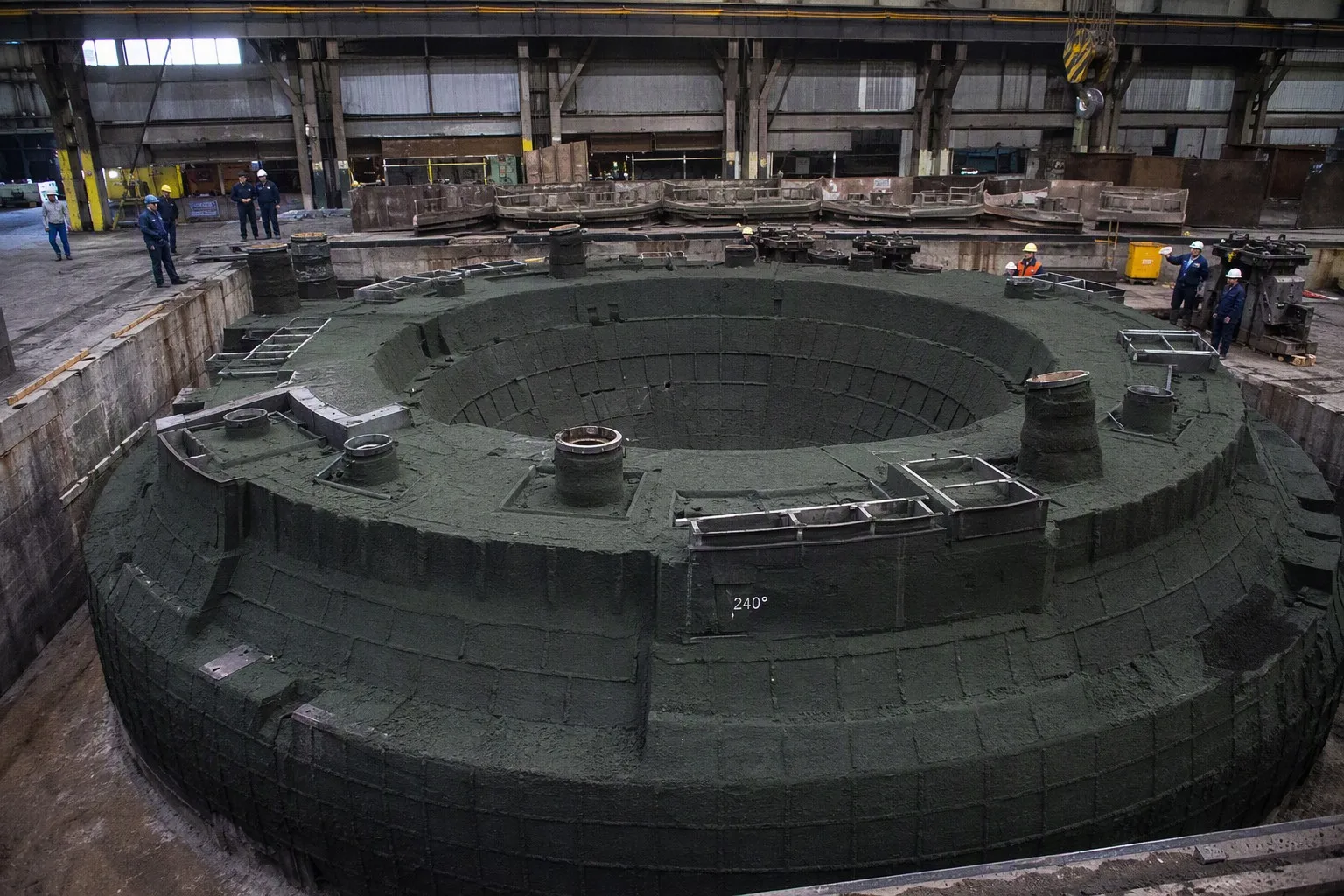
For 10–50 ton castings, the mold is built in a pit or on a large molding floor:
| Step | Description |
|---|---|
| Mold assembly | Cope and drag assembled in a molding pit; flaskless molding with steel-strapped cope sections is common for very large pots |
| Core construction | The interior core is assembled from multiple core segments, jointed to form the pot cavity; core venting through the base |
| Mold wash | Zircon or chromite-based refractory wash applied to the cavity surface to prevent metal penetration and improve surface finish |
| Drying | Mold and cores dried to remove residual moisture — critical for gas defect prevention in heavy-section steel |
| Parameter | Slag Pot Casting Practice |
|---|---|
| Melting | Electric arc furnace (EAF) with refining; or induction furnace for smaller pots |
| Deoxidation | Aluminum or silicon-calcium deoxidation; vacuum degassing for premium quality |
| Pouring temperature | 1,560–1,620 °C (superheat 60–100 °C above liquidus) |
| Pouring method | Bottom-pour ladle with stopper rod — minimizes slag carryover; multiple ladles for pots over 30 tons (tandem pouring) |
| Pouring rate | Controlled to avoid turbulence and mold erosion; typically 10–20 minutes for a 40-ton pour |
For a 40-ton casting, complete solidification can take 24–72 hours. The cooling strategy is critical:
| Operation | Purpose |
|---|---|
| Grinding | Remove riser stubs, gates, and surface defects |
| Weld repair | Repair localized surface defects with qualified WPS and preheat (200–300 °C); followed by PWHT if required |
| Shot blasting | Remove residual sand and scale; provides clean surface for inspection and painting |
| Dimensional check | Verify critical dimensions (trunnion spacing, rim profile, wall thickness via UT) |
Despite their massive size, most slag pots require precision machining on critical features:
| Machined Feature | Process | Tolerance |
|---|---|---|
| Trunnion diameters and faces | Horizontal boring mill or large lathe | ±0.05 mm on diameter; ±0.1 mm on face positions |
 |Trunnion-to-trunnion concentricity| Boring in one set-up; or laser alignment | ±0.2 mm | |Trunnion bosses (for bolted trunnions)| Boring mill — drill and tap bolt pattern | ±0.5 mm pattern position | |Pot lip face (if leveled)| Facing operation on horizontal boring mill | ±0.5 mm | |Lifting lug holes| Drill and bore | ±0.2 mm |
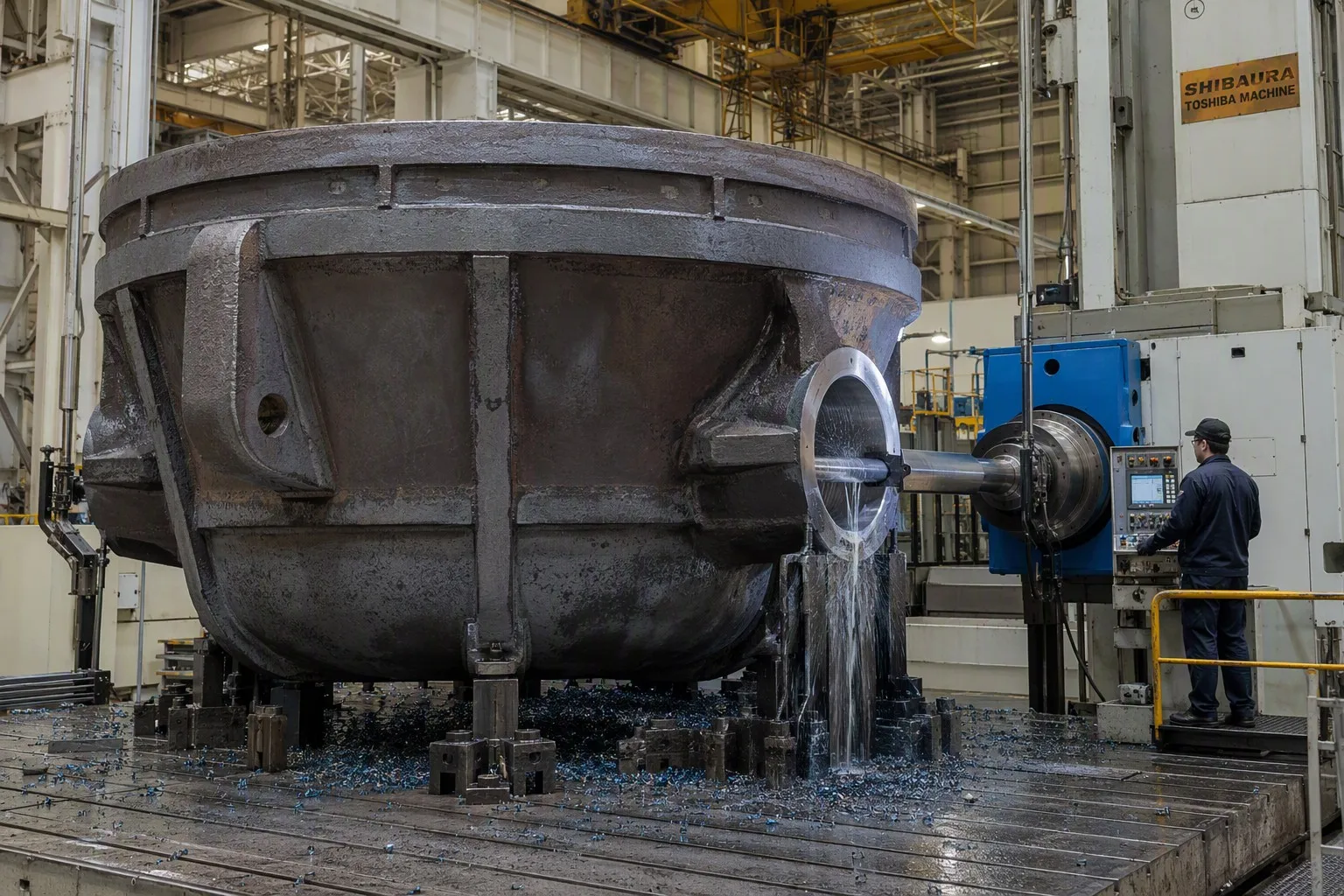
Trunnion machining is performed on horizontal boring mills with spindle sizes of 130–200 mm. The pot is positioned on floor plates with the trunnion axis level; both trunnions are machined in the same set-up to guarantee concentricity.
At Dandong City Pengxin Machinery Co., Ltd., slag pot trunnions are machined on large horizontal boring mills with in-process measurement, achieving the concentricity required for smooth crane hook engagement and carrier operation.
| NDT Method | Extent | Purpose |
|---|---|---|
| Visual (VT) | 100% | Surface defects, weld quality |
| Magnetic particle (MT) | 100% of accessible surfaces | Surface and near-surface cracks, especially at trunnion junctions and rim |
| Ultrasonic (UT) | All critical sections (trunnion bosses, bottom, wall junctions) | Internal shrinkage, porosity, inclusions |
| Dye penetrant (PT) | Machined surfaces (trunnions, lugs) | Surface-breaking defects on machined features |
| Load test (optional) | Trunnions — proof load at 125–150% of design load | Verify trunnion structural integrity |
Slag pots are typically purchased to customer-developed specifications referencing international standards:
| Standard | Application |
|---|---|
| ASTM A216 / A217 | Carbon steel / alloy steel casting grades |
| EN 10213 | Steel casting grades for pressure purposes (used as chemistry basis) |
| ISO 4990 | Steel castings — general technical delivery requirements |
| ISO 8062 | Castings — system of dimensional tolerances |
| ASTM A609 | Ultrasonic examination of steel castings |
| ASTM E709 / E165 | MT and PT methods |
| EN 10204 | Material certificate types (3.1/3.2) |
| Test | Frequency | Acceptance |
|---|---|---|
| Chemical analysis | Every heat | Per specification chemistry |
| Tensile test | Every heat (test bar cast with pot) | UTS, YS, elongation per specification |
| Charpy impact | Every heat (where specified) | ≥27 J average at specified temperature |
| Hardness | Every pot | 140–180 HB typical |
| UT of critical sections | Every pot | No defects exceeding specification limits |
| MT of trunnion junctions | Every pot | No linear indications |
| Trunnion load test | First article / periodic | No permanent deformation at 125–150% load |
| Dimensional inspection | Every pot | Per drawing |
A complete slag pot delivery documentation package includes:
| Service Frequency | Expected Life (without major repair) | Life Extension Strategy |
|---|---|---|
| Low frequency (<5 cycles/day) | 5–8 years | Standard maintenance |
| Medium frequency (5–15 cycles/day) | 3–6 years | Periodic weld repair of rim cracks |
| High frequency (>15 cycles/day) | 2–4 years | Replaceable rim band; regular inspection program |
| Defect | Location | Root Cause | Mitigation |
|---|---|---|---|
| Rim cracks | Pot lip | Thermal fatigue; slag overflow; water quenching | Radius design improvement; replaceable rim; controlled cooling |
| Trunnion cracking | Trunnion-to-body junction | Fatigue from repeated lifting; casting defects at junction | MT inspection every 6 months; weld repair with preheat and PWHT |
| Body wall cracking | Wall sections, transitions | Thermal fatigue; section design | Improved transition radii; material upgrade (Cr-Mo) |
| Erosion/corrosion | Interior surface | Slag chemical attack; oxidation | Interior refractory coating; sacrificial liner |
| Deformation | Rim ovality | Creep at elevated temperature; uneven slag loading | Material with better creep resistance; avoid overfilling |
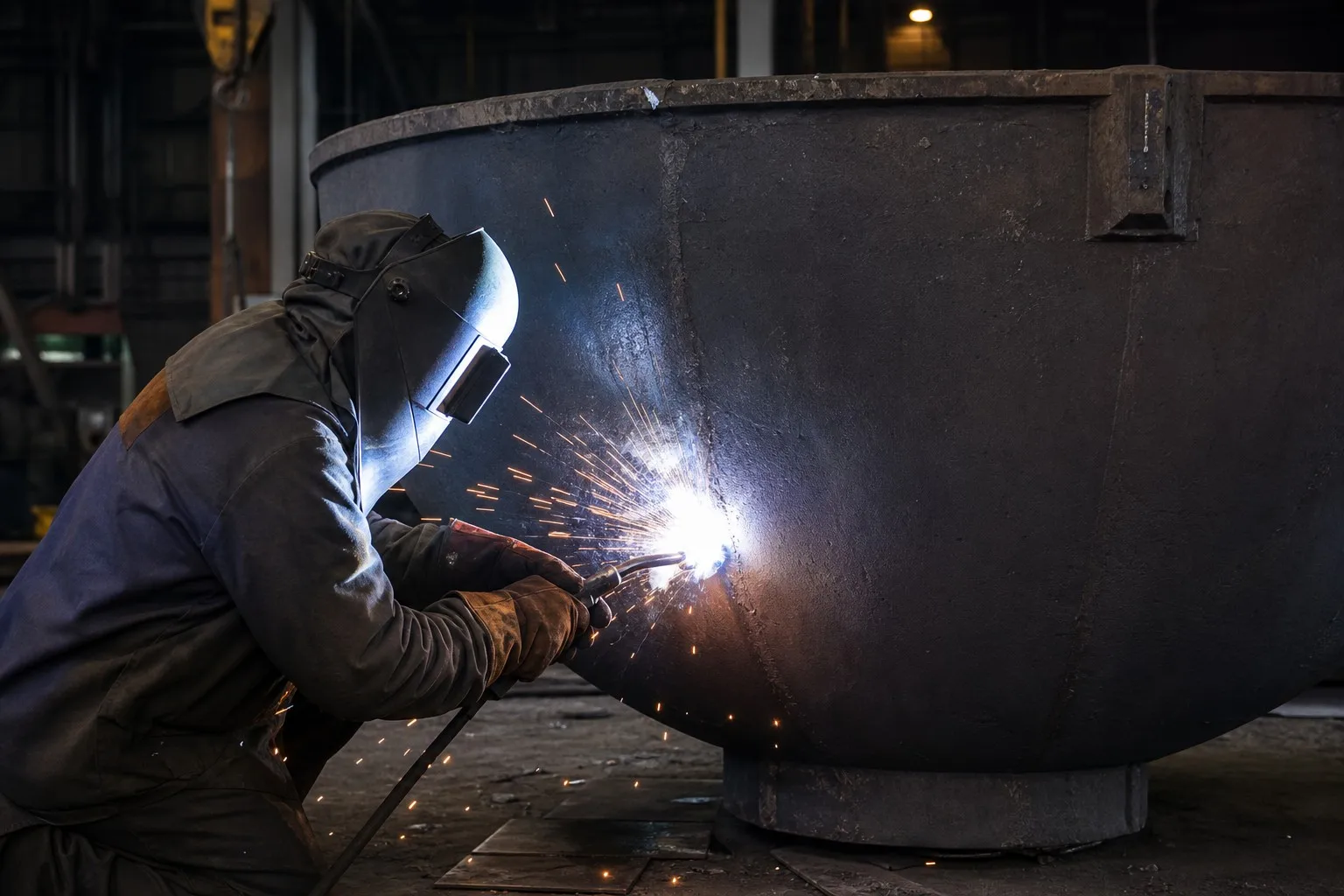
Slag pot weld repair is an established practice — pots are routinely refurbished rather than replaced:
Not every foundry can produce quality slag pots. The combination of heavy-section casting expertise, large-capacity molding, big-heat melting, integrated machining, and thermal-fatigue metallurgy knowledge is rare. When qualifying a slag pot supplier, verify:
| Capability | Why It Matters |
|---|---|
| Maximum single-casting weight | Must exceed your pot weight by 25%+ (riser allowance) |
| Molding floor / pit capacity | Must physically accommodate the mold |
| Heat treatment furnace size | Must accommodate the pot with support fixturing |
| Horizontal boring mill capacity | Trunnion machining requires large-bore capability |
| Melting capacity per heat | Multiple-ladle pouring for pots over 25 tons adds risk — single-ladle capability preferred |
| NDT infrastructure | In-house UT/MT with qualified inspectors |
| Slag pot track record | Ask for references: mill name, pot size, service life achieved |
| Design engineering support | Thermal fatigue analysis; section optimization; material recommendations |
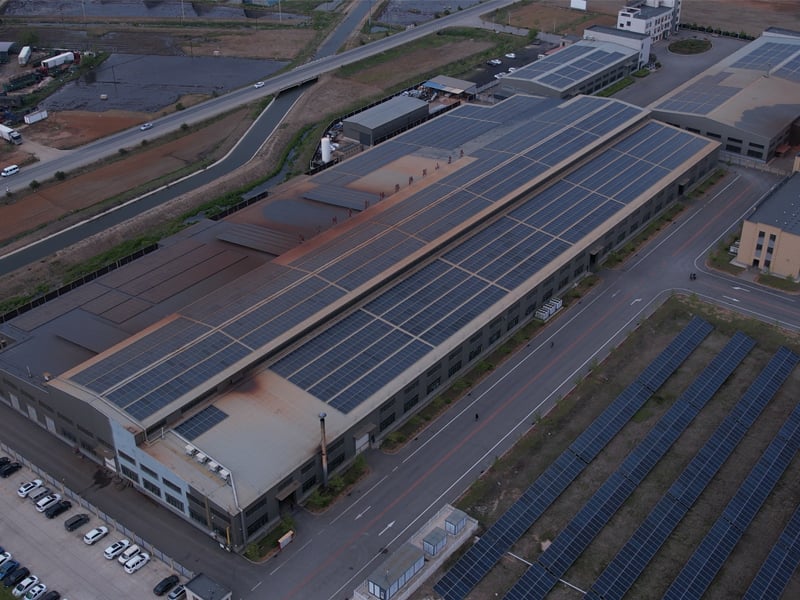
Dandong City Pengxin Machinery Co., Ltd. has been manufacturing heavy industrial steel castings since 1958, with slag pots among its flagship products. With an 80,000 m² facility, casting weights up to 25 tons per piece, in-house large horizontal boring mills for trunnion machining, and complete heat treatment and NDT infrastructure, the company supplies slag pots to steel mills across China and international markets — backed by ISO 9001 certification and full EN 10204 documentation.
The slag pot is a masterclass in heavy engineering: a single casting that must survive thousands of thermal cycles, carry 100-ton loads through its trunnions, resist chemical attack from molten slag, and remain repairable for a decade or more of service. Every stage of its manufacture — pattern design, melting, pouring, heat treatment, machining, and NDT — demands the discipline of a mature heavy casting operation.
Key takeaways:
Need slag pots for your steelmaking operation? Dandong City Pengxin Machinery Co., Ltd. provides custom slag pot design, casting up to 25 tons, integrated trunnion machining, complete heat treatment and NDT, with documented quality per EN 10204. Contact us with your pot capacity and service conditions for an engineering quotation.
 Hot News
2026-10-16
2026-10-09
2026-10-02
2026-09-25
2026-09-18
2026-09-11

Dandong City Pengxin Machinery was founded in 1958, is a set of casting, machining and assembly as one of the private enterprises.
Wangjiapu Group, Xinan Village, Qianyang Town, Donggang City, Dandong City, Liaoning Province, China
Copyright © Dandong City Pengxin Machinery Co.,Ltd. All Rights Reserved Privacy Policy Blog
 EN
EN