 EN
EN
Meta Description: A comprehensive technical guide to heavy cast steel rotary kiln tyres (riding rings) and supporting roller assemblies for cement and mineral processing plants. Learn 42CrMo4 and ZG35CrMo metallurgy, heavy 30 to 60-ton directional feeding design, vertical turning to <=0.05 mm runout, and kiln shell shrink-fit mounting.
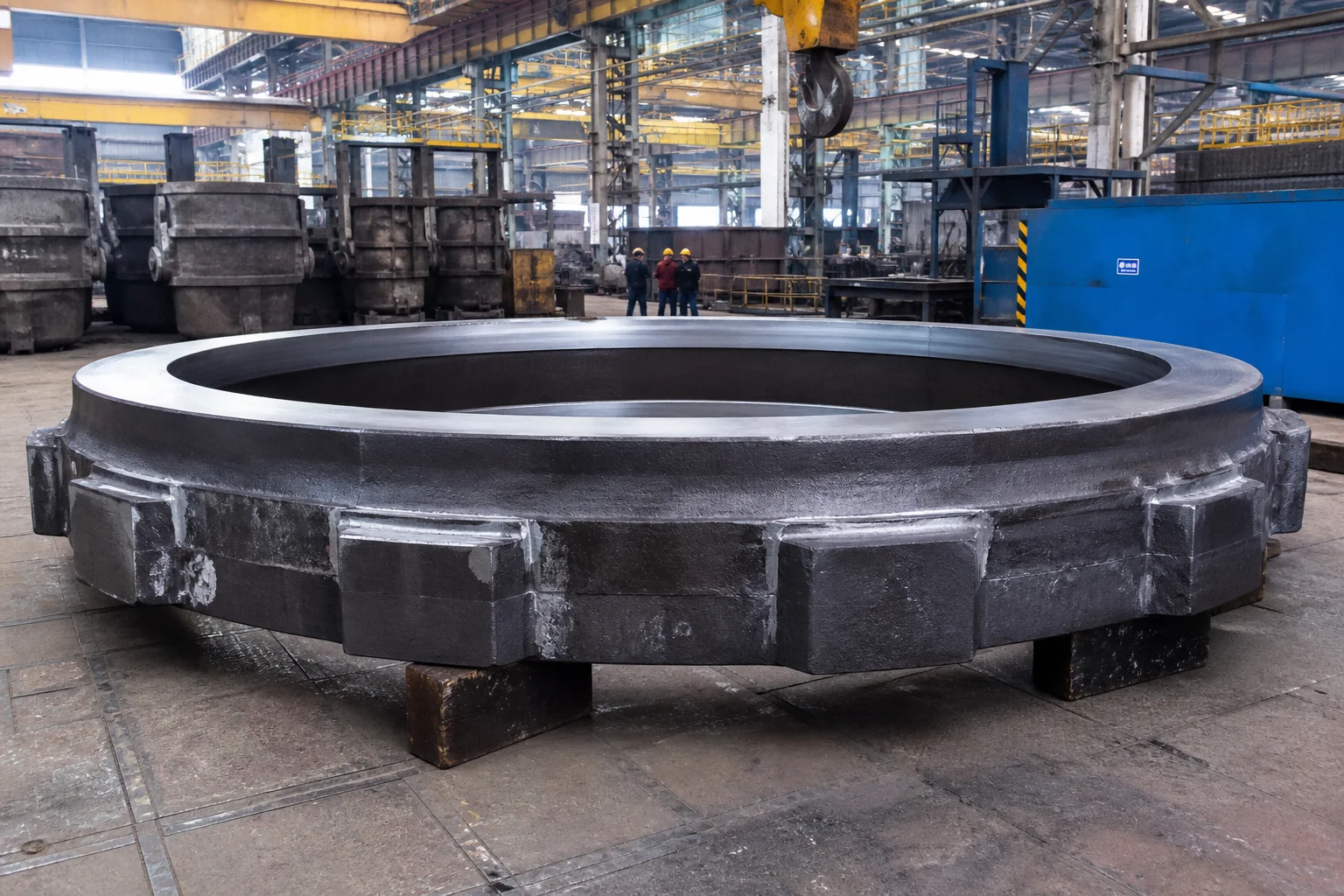
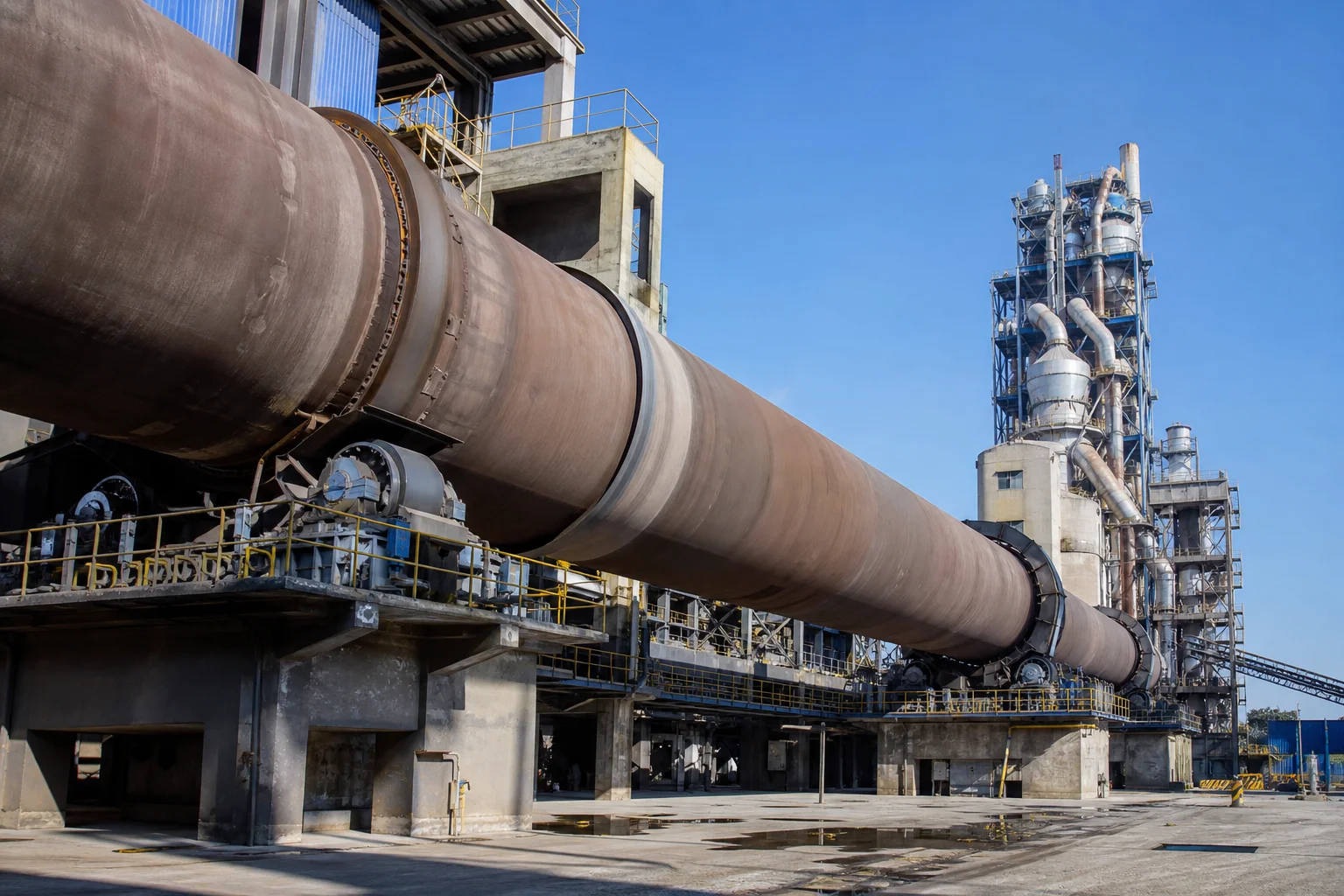
In heavy cement clinker manufacturing, lime production, metallurgical roasting, and nickel-laterite rotary kilns, rotary kiln tyres (riding rings) and supporting roller stations are the critical mechanical load-bearing foundations. A modern 5,000 to 10,000 ton/day cement rotary kiln can measure 4.0 to 6.5 meters in diameter, extend over 60 to 120 meters in length, and weigh between 1,500 and 4,000 metric tons in full operating charge.
The entire rotating kiln mass is supported on only three or four massive cast steel tyre stations:
- Rotary Kiln Tyre (Riding Ring): Weighing between 25 and 65 metric tons, each monolithic cast steel ring rides continuously on paired supporting rollers, enduring extreme contact Hertzian shear stresses, high-temperature thermal conduction (), and cyclic hoop ovalization forces.
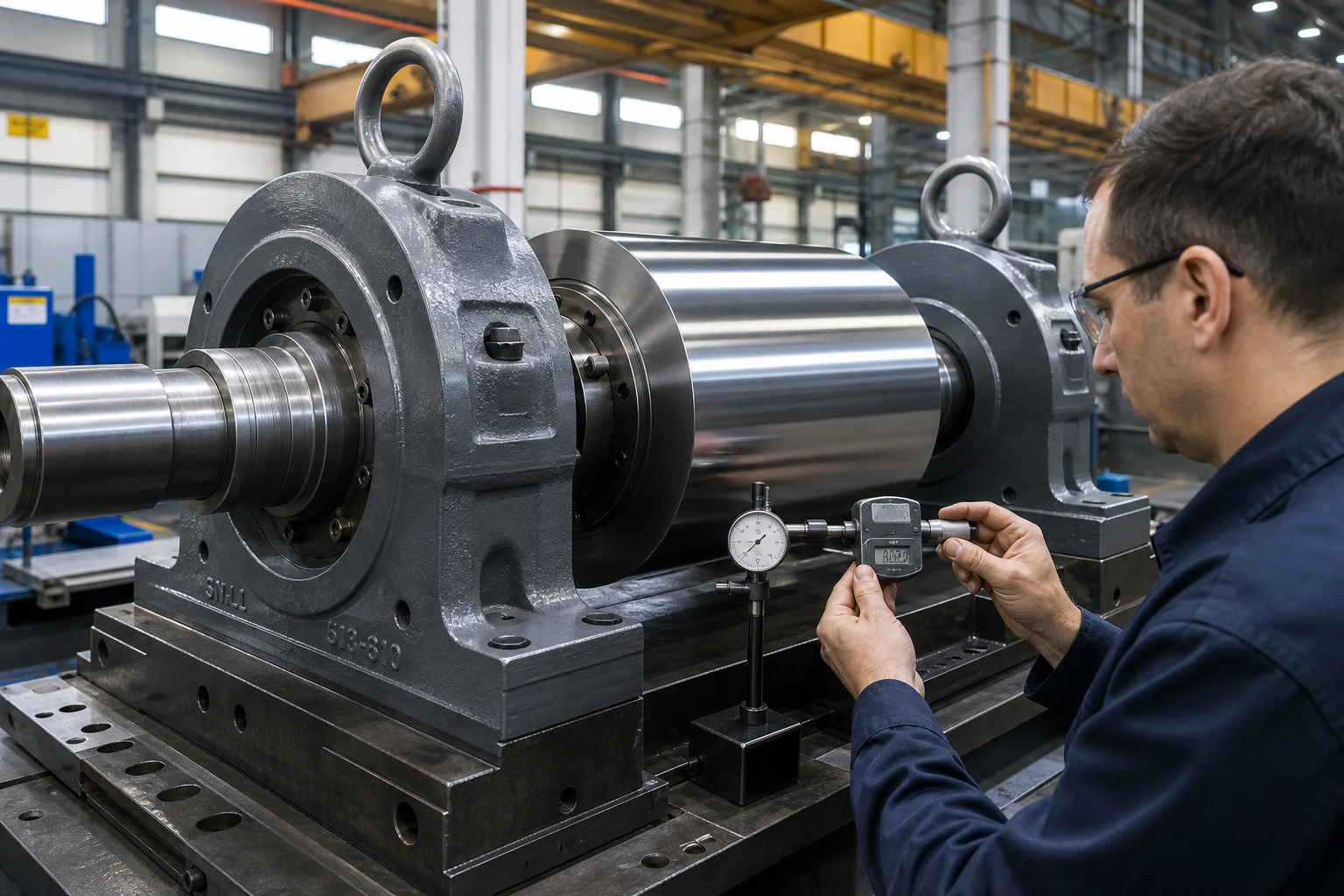
- Supporting Roller Assemblies: Massive forged or cast alloy steel rollers mounted on forged shafts and heavy spherical roller bearings that carry millions of Newtons of continuous radial load.
Under these punishing conditions, structural integrity is non-negotiable. A subsurface shrinkage cavity in a tyre ring or an un-tempered martensitic segregation pocket in a roller rolling face will trigger catastrophic subsurface Hertzian fatigue spalling (crater flaking), through-thickness transverse cracking, or severe bore ovalization, halting entire cement production lines and costing hundreds of thousands of dollars per day in lost output.
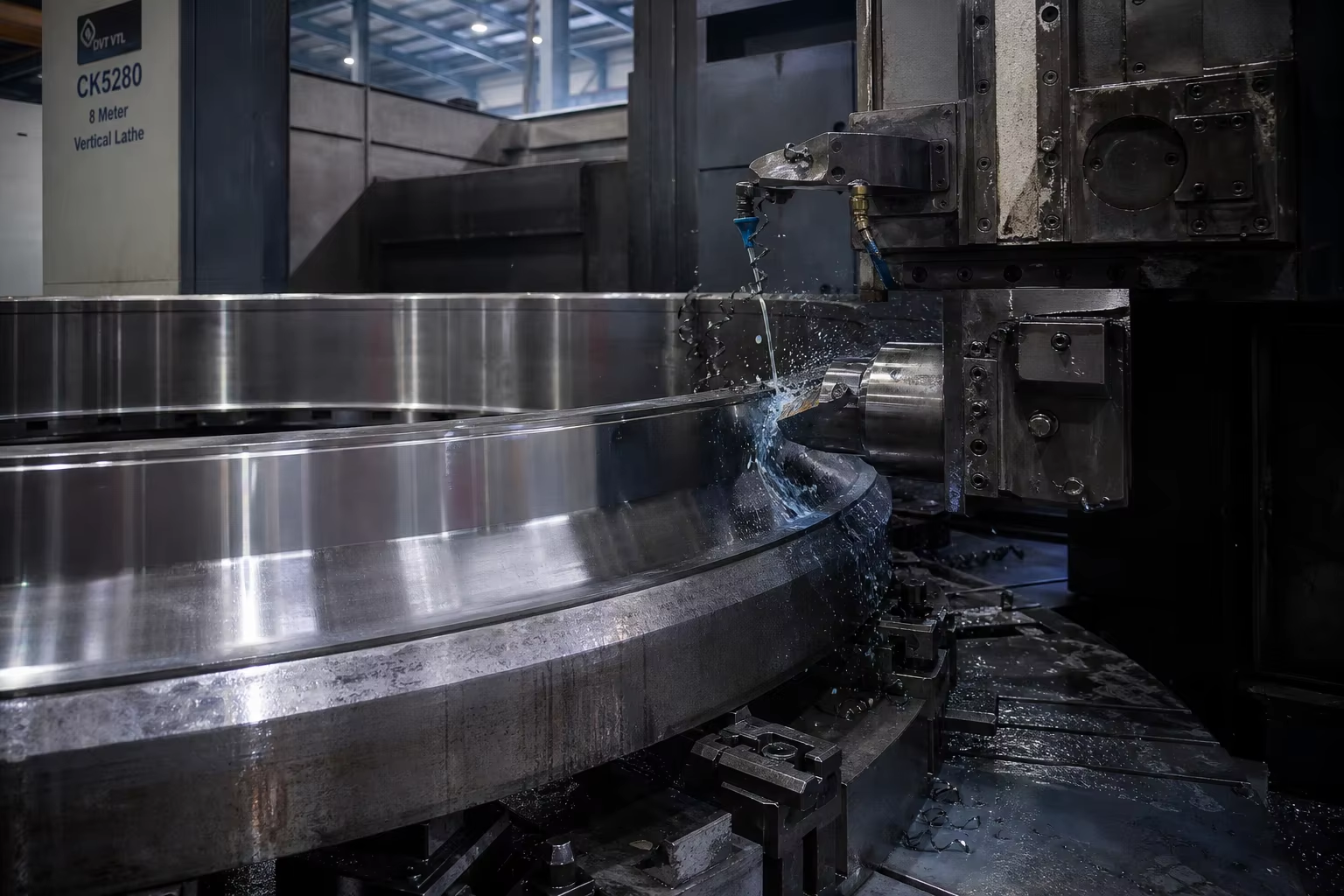
Achieving extreme service longevity requires specialized heavy casting engineering: casting High-Strength Quenched & Tempered Alloy Steels (ZG35CrMo, 42CrMo4, and ASTM A148 Gr 105-85), calculating multi-riser directional solidification for solid ring sections, executing precision vertical turning on 8-meter CNC vertical lathes (Total Indicated Runout ), and conducting 100% volumetric ultrasonic testing per EN 10228-3 Class 3.
This comprehensive guide details the alloy metallurgy, solidification modeling, Q&T heat treatment, large-envelope CNC machining, and thermal shrink-fit installation calculations for cement kiln tyres and supporting rollers.
1. Operating Dynamic Load Fields & Failure Modes
                     ┌──────────────────────────────────────────────┐
                     │ Massive Kiln Static & Dynamic Mass (>2,000 T)│
                     └──────────────────────┬───────────────────────┘
                                            │
        ┌───────────────────────────────────┼───────────────────────────────────┐
        ▼                                   ▼                                   ▼
┌───────────────────────────────┐ ┌───────────────────────────────┐ ┌───────────────────────────────┐
│ Subsurface Hertzian Spalling  │ │ Transverse Ring Fracture      │ │ Kiln Shell Constriction / Gap │
│ (Shear stress peak 5-12 mm    │ │ (Bending fatigue initiating at│ │ (Excessive clearance causing  │
│  below tyre contact face)     │ │  subsurface shrinkage pores)  │ │  waddling & shell distortion) │
└───────────────────────────────┘ └───────────────────────────────┘ └───────────────────────────────┘| Operating Component | Operating Load & Environment | Critical Failure Mode | Material Grade Solution |
|---|---|---|---|
| Rotary Kiln Tyre (Riding Ring) | radial load per roller station + heat | Subsurface Hertzian spalling, transverse section cracking | Cast Alloy Steel (ZG35CrMo / 42CrMo4 / ASTM A148 Gr 105-85) |
| Supporting Roller Body | Continuous high-pressure rolling friction + axial thrust | Surface pitting, flat spotting, shaft journal fatigue | Forged/Cast 42CrMo4 / ZG35CrMo Q&T (210–260 HB) |
 |Kiln Shell Under-Tyre Pads| Thermal expansion sliding + high friction abrasion | Pad crushing, severe wear, weld cracking to shell |High-Toughness Structural Cast Steel (GS-20Mn5 / ASTM A216 WCB)| |Thrust Roller (Hydraulic / Mechanical)| Axial thrust skew loads () | Flange edge spalling, guide wear |Quenched & Tempered 40Cr / 42CrMo4|
2. Heavy Alloy Steel Metallurgy & Material Selection
Cast steel tyres feature massive rectangular cross-sections ( thickness, axial width). High deep-hardenability alloying is essential to achieve a uniform tempered sorbite structure through the entire section:
| Material Standard | Common Equivalent Grades | Nominal Chemical Composition (wt%) | Heat Treatment | Mechanical Properties | Application Role |
|---|---|---|---|---|---|
| ASTM A148 Gr 90-60 / ZG270-500 | EN 10293 GS-20Mn5 / 1.1120 | Normalized & Tempered | Standard kiln tyres ( dia.), cooler riding rings | ||
| ASTM A148 Gr 105-85 / ZG35CrMo | EN 10293 G34CrMo4 / 1.7220 | Quenched & Tempered (Q&T) | Heavy-duty kiln tyres, heavy supporting rollers () | ||
| High-Strength Cr-Mo Steel | 42CrMo4 / DIN 1.7225 / ZG42CrMo | Quenched & Tempered (Q&T) | High-load supporting rollers, extreme tonnage riding rings | ||
| Ni-Cr-Mo Heavy Cast Steel | 34CrNiMo6 / DIN 1.6582 | Quenched & Tempered (Q&T) | Extreme cold-climate kiln tyres (verified Charpy impact at ) |
Key Metallurgical Controls:
- Hardness Differential Rule: The supporting roller hardness must be engineered higher than the tyre ring hardness (e.g., Tyre: , Roller: ). This ensures uniform sacrificial wear and prevents roller corrugated washboarding.
- Vacuum Degassing (VD): Ladle refining reduces dissolved hydrogen () and sulfur (), preventing internal hydrogen embrittlement flakes in massive 40-ton steel sections.
3. Directional Solidification & Heavy Thermal Modulus Risering
Casting 40 to 60-ton monolithic steel rings with thermal moduli exceeding requires disciplined directional feeding to eliminate centerline shrinkage cavities:
┌─────────────────────────────────────────────────────────────┐
│ 1. 3D Precision Master Tooling & Pit Molding Architecture   │
│    • Heavy concrete-reinforced pit molding in foundry floor │
├─────────────────────────────────────────────────────────────┤
│ 2. Furan Resin Sand with Zircon Wash Facing                 │
│    • High mold rigidity prevents mold dilation under 60 tons│
│      liquid ferrostatic pressure                            │
├─────────────────────────────────────────────────────────────┤
│ 3. Multi-Riser Exothermic Feeding Ring System (8 to 12 Risers)
│    • Massive insulated exothermic feeder sleeves over top   │
│      circumference ($M_{\text{riser}} \ge 1.4 \times M_{\text{ring}}$) │
├─────────────────────────────────────────────────────────────┤
│ 4. Tangential Bottom-Swirl Dual-Ladle Pouring System         │
│    • Two heavy ladles pouring synchronously; zero cold shuts│
└─────────────────────────────────────────────────────────────┘
4. Multi-Stage Normalizing & Tempering (Q&T) Heat Treatment
As-Cast Steel Tyre Ring (~60 Tons)
                │
                ▼
┌────────────────────────────────────────────────────────┐
│ 1. Full High-Temperature Normalizing (880 °C – 920 °C) │
│    (Soaked for 18–24 hours to break coarse dendrites)  │
└───────────────┬────────────────────────────────────────┘
                │
                ▼  Forced Air Blast / High-Agitation Polymer
┌────────────────────────────────────────────────────────┐
│ 2. Severe Quenching / Accelerated Cooling              │
│    (Transforms heavy section to fine Martensite/Bainite)│
└───────────────┬────────────────────────────────────────┘
                │
                ▼
┌────────────────────────────────────────────────────────┐
│ 3. High-Temperature Tempering (600 °C – 650 °C)        │
│    (Soaked for 24 hours; relieves all internal stress;  │
│     produces uniform Tempered Sorbite, 190–230 HB)     │
└────────────────────────────────────────────────────────┘
5. Large-Envelope Vertical CNC Turning & Bore Profiling
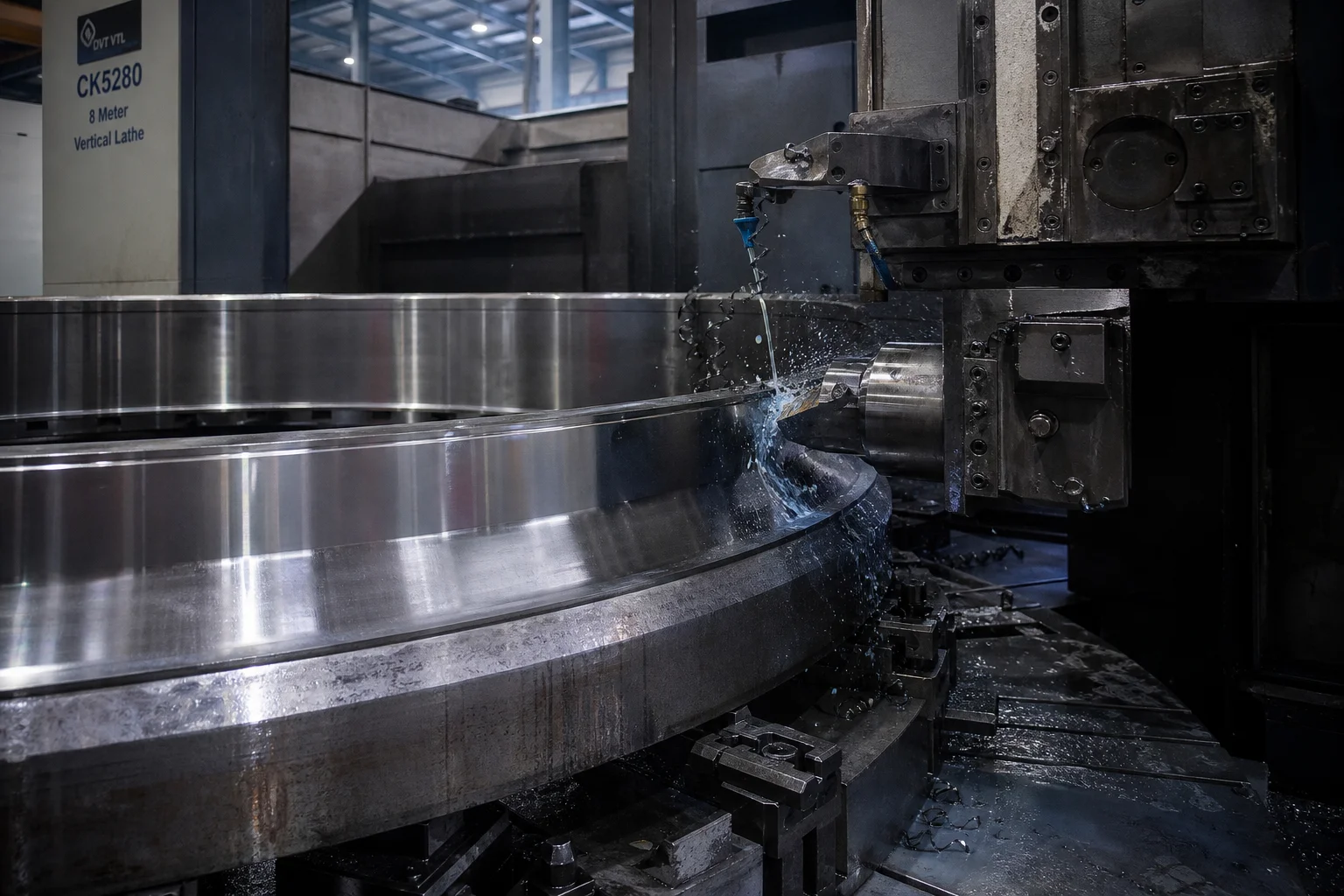
Tyre geometry dictates kiln rotational alignment, drive motor power consumption, and mechanical vibration:
Precision Machining Operations:
- Outer Diameter (OD) Rolling Face Turning: Machined on heavy 8-meter CNC vertical turning lathes (VTL). Total Radial Runout (TIR) across a 5.5-meter diameter ring is held within , with surface roughness .
- Inner Diameter (ID) Bore Profile Machining: Precision turning of the cylindrical or tapered inner bore. Bore cylindricity is held within to guarantee uniform thermal clearance contact against kiln shell mounting pads.
- Side Thrust Faces: Parallelism between side guide faces is maintained within around the full circumference.
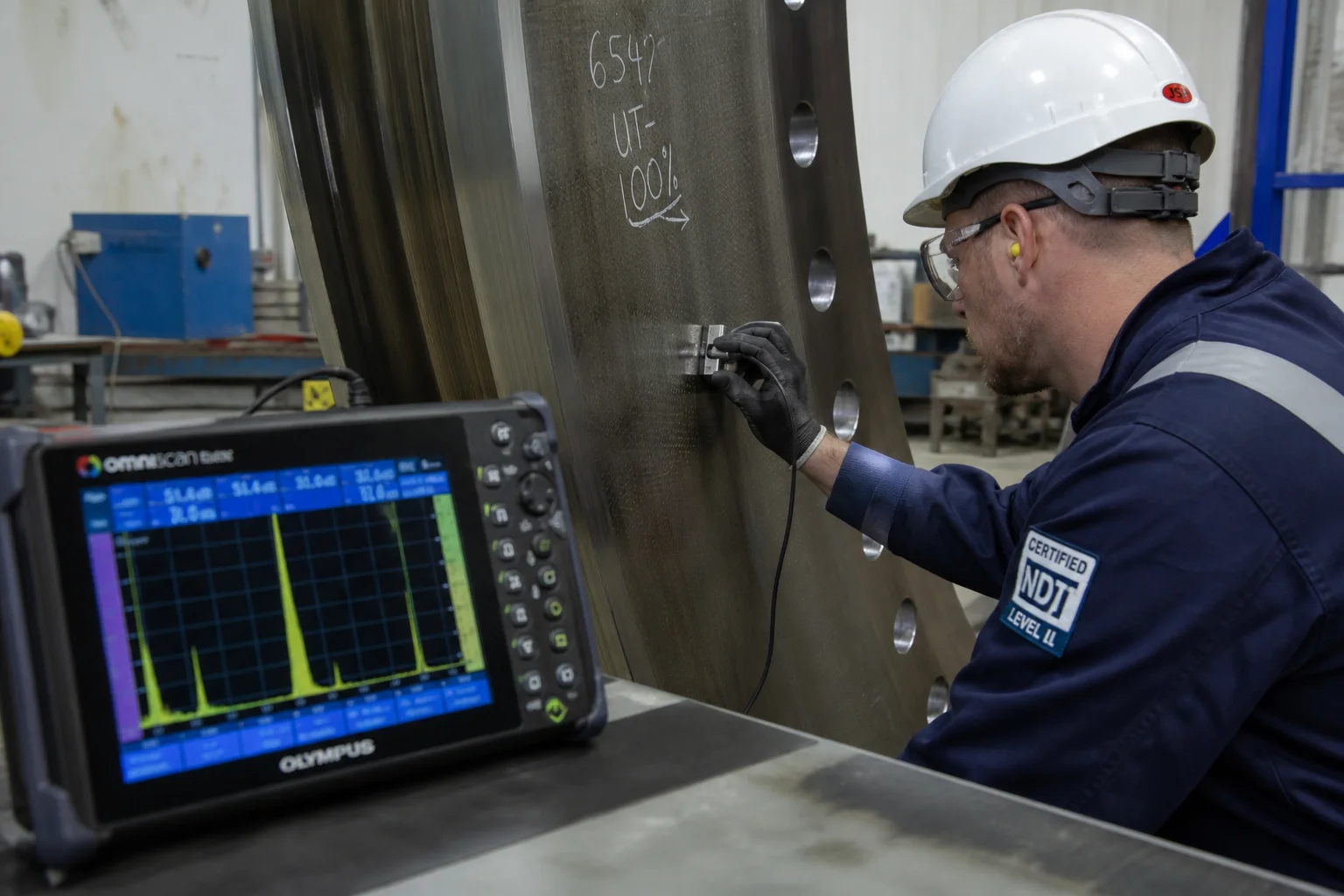
6. Comprehensive Non-Destructive Quality Verification
| Inspection Parameter | Testing Standard | Acceptance Criteria |
|---|---|---|
| Ultrasonic Testing (UT) | EN 10228-3 Class 3 / ASTM A609 Level 1 | 100% volumetric grid scan of rolling face and bore; zero internal defect indications exceeding FBH |
| Magnetic Particle Testing (MT) | EN 10228-1 / ASTM E709 (Fluorescent) | 100% coverage of outer rolling face, chamfers, and inner bore; zero linear crack indications |
| Hardness Survey | Portable Brinell Hardness per ASTM E10 | 12 equidistant points around outer circumference; hardness within () |
| 3D Laser Tracker Geometry | 3D Laser Tracker (SpatialAnalyzer) | Full verification of OD, ID, face width, and radial runout within CAD print specifications |
| Mechanical Properties | ISO 6892-1 / ASTM E23 on attached test coupons | Verified ; Charpy impact at |
7. Heavy Kiln Casting Capabilities at Dandong City Pengxin Machinery Co., Ltd.
Delivering 20 to 60-ton rotary kiln tyres and supporting rollers requires massive crane lifting capacity, large deep pit molding facilities, heavy heat-treatment furnaces, and large-envelope CNC vertical lathes.
Dandong City Pengxin Machinery Co., Ltd. delivers fully certified, turnkey finished cement kiln tyres and supporting roller assemblies:
- Heavy Tonnage Production Infrastructure: 80,000 m² heavy casting plant with dual heavy overhead cranes capable of pouring single alloy steel castings up to 60 tons.
- Comprehensive Alloy Expertise: Certified production of ZG35CrMo, 42CrMo4, 34CrNiMo6, and ASTM A148 heavy structural cast steels.
- Large-Envelope CNC Vertical Machining: Large 8-meter CNC vertical turning lathes delivering finished rolling faces with runouts .
- In-House Heavy Heat Treatment: Computer-controlled bogie-hearth normalizing and tempering furnaces capable of handling 60-ton rings with multi-channel thermocouple tracking.
- Complete Quality Certification: ISO 9001 certified, providing full EN 10204 3.1 & 3.2 material test certificates, 100% UT/MT reports, and 3D laser tracker inspection records.
Conclusion
Rotary kiln tyres and supporting rollers are the critical rotating lifelines of the global cement, lime, and mineral processing industries. Operating for decades under thousands of tons of dynamic rolling load demands clean vacuum-degassed alloy steel metallurgy (ZG35CrMo / 42CrMo4), scientific directional solidification, precision 8-meter CNC vertical turning, and 100% volumetric ultrasonic inspection.
Partnering with an experienced, integrated heavy casting and precision machining powerhouse ensures that your rotary kilns run smoothly, efficiently, and without unplanned shutdown.
Contact Dandong City Pengxin Machinery Co., Ltd. to submit your rotary kiln tyre or supporting roller drawings.
Dandong City Pengxin Machinery Co., Ltd. — Heavy Castings and Precision Machining, Since 1958.
Table of Contents
- 1. Operating Dynamic Load Fields & Failure Modes
- 2. Heavy Alloy Steel Metallurgy & Material Selection
- 3. Directional Solidification & Heavy Thermal Modulus Risering
- 4. Multi-Stage Normalizing & Tempering (Q&T) Heat Treatment
- 5. Large-Envelope Vertical CNC Turning & Bore Profiling
- 6. Comprehensive Non-Destructive Quality Verification
- 7. Heavy Kiln Casting Capabilities at Dandong City Pengxin Machinery Co., Ltd.
- Conclusion